



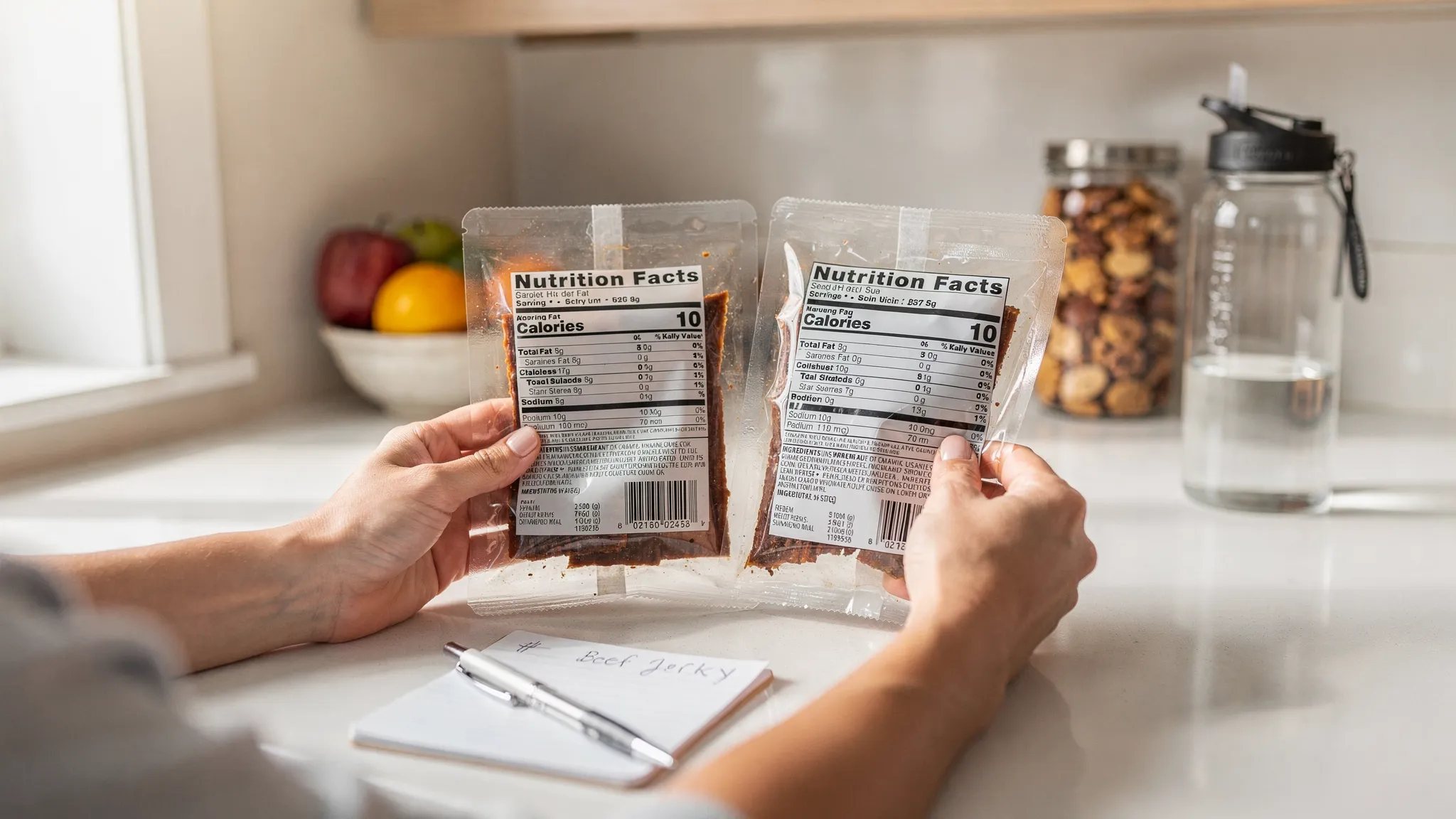
Beef jerky can be a smart, high-protein snack, but “healthy” depends on what’s inside the bag and how it fits your needs (weight goals, blood pressure, sugar intake, food sensitivities). The tricky part is that jerky is also one of the easiest categories to “health-halo” with buzzwords while still packing a lot of sodium, added sugar, or curing agents.
This guide is built for label readers. You’ll learn which signals are meaningful, which claims are mostly marketing, and how to compare healthy beef jerky options in under a minute.

What “healthy beef jerky” usually means (and what it doesn’t)
Most people shopping for healthy beef jerky are looking for three outcomes:
- High protein for the calories (to stay full, support training, or avoid a carb-heavy snack)
- Low or no added sugar (for metabolic goals, low-carb eating, or simply to avoid “candy jerky”)
- Reasonable sodium and minimal additives (especially for blood pressure concerns)
Jerky is dried and seasoned meat, so it will almost always be more concentrated in sodium than fresh meat. “Healthy” often means choosing the best option within the category, not finding a salt-free, ingredient-free unicorn.
A helpful way to think about it: your goal is usually better macros, fewer unnecessary ingredients, and transparency.
Labels you can trust (because they’re defined or regulated)
Some label elements are enforced by regulators or third-party certifiers. These are the ones worth weighting heavily.
Nutrition Facts and serving size
In the U.S., packaged foods must follow FDA nutrition labeling rules for most products, including standardized calories, macros, and percent Daily Value (%DV) formatting. Start here because it’s hard to “spin” a Nutrition Facts panel.
Two label moves matter most:
- Serving size: Jerky is often listed as 1 oz (28 g), but some bags contain multiple servings. If you eat the whole bag, multiply everything.
- %DV: It lets you compare fast. For sodium, the U.S. Daily Value is 2,300 mg/day.
USDA inspection legend (for meat products)
For meat jerky, you’ll often see the USDA inspection legend or an establishment number on the package. That mark indicates the product was produced under USDA food safety inspection (a meaningful baseline for safety and processing controls). You can learn more about inspection basics from USDA FSIS.
Certified gluten-free (when you need it)
“Gluten-free” can be used as a claim, but third-party certification is a stronger signal for people with celiac disease or high sensitivity. This matters in jerky because marinades often include soy sauce, malt flavoring, or other hidden sources.
USDA Organic (if you prioritize ingredient standards)
If a jerky is labeled organic, it must meet USDA organic standards, which restrict many inputs and require audited handling. It doesn’t automatically mean “low sodium” or “low sugar,” but it does mean the ingredient sourcing and processing rules are stricter.
Claims to be skeptical of (not useless, just not enough)
Jerky packaging is full of attention-grabbing language. Some of it can be true, but it rarely answers the questions health-focused shoppers actually have.
“All natural”
This is loosely defined and varies by category. Even when used correctly, it does not guarantee low sodium, low sugar, or minimal processing.
“Keto,” “paleo,” or “clean”
These terms aren’t tightly regulated definitions. Treat them as starting points, then verify the Nutrition Facts and ingredients.
“No nitrates added”
This is a classic one to interpret carefully. Many products that say “no nitrates added” use celery powder or celery juice (a natural nitrate source) plus a bacterial culture to convert nitrates to nitrites during curing. Functionally, your body may still be exposed to nitrite. USDA labeling rules allow this phrasing when synthetic nitrates/nitrites aren’t directly added, but the curing chemistry can be similar.
If you’re trying to reduce cured/processed meat exposure, read the ingredient list, not just the front of the bag.
The biggest “healthy jerky” traps (and how to spot them fast)
Trap 1: Added sugar disguised as “flavor”
A little sugar can balance salt and spice, but some jerkies creep into dessert territory, especially in teriyaki-style or sweet heat flavors.
Look at Total Sugars and Added Sugars on the Nutrition Facts panel. Then scan ingredients for sugar aliases, such as:
- Brown sugar, cane sugar, coconut sugar
- Honey, molasses
- Maple syrup, agave
- Corn syrup, rice syrup
- Dextrose
If you’re buying healthy beef jerky for weight loss or low-carb eating, “sweet” is not automatically bad, but you should choose intentionally.
Trap 2: Sodium that looks fine until you do the math
Jerky is salty because salt helps preservation and taste. Still, sodium varies widely.
A practical rule: use the %DV line to compare options quickly. The American Heart Association recommends no more than 2,300 mg/day, and notes an ideal limit of 1,500 mg/day for many adults.
If one serving of jerky delivers 25% to 35% of your daily sodium, it can still fit your day, but it becomes a “budget buster” if the rest of your meals are also salty.
Trap 3: “Protein-per-bag” optics
Some brands advertise big protein numbers on the front, but the bag may contain 2 to 3 servings. Compare protein per serving and confirm how much you realistically eat.
Trap 4: Ultra-long ingredient lists
A longer list is not always unhealthy (spices add length fast), but it can signal heavy flavor engineering. If your goal is “simple,” look for a short list built around meat, salt, spices, and perhaps a minimal sweetener.
Trap 5: “No MSG” as a health shortcut
Some people avoid MSG for personal reasons, but “no MSG” does not automatically mean “minimally processed.” Many products use flavor boosters like yeast extract or hydrolyzed proteins. If you’re sensitive, read carefully. If you’re not, it’s usually not the most important health lever compared to sodium and added sugar.
A quick scorecard for comparing healthy beef jerky labels
Use this table as a fast, repeatable way to compare options side by side.
| Label item | What to check | Why it matters | A better sign |
|---|---|---|---|
| Serving size | Ounces per serving and servings per container | Prevents “healthy” numbers that only work for tiny portions | 1 oz serving with clearly stated servings per bag |
| Protein | Grams per serving | Higher protein improves satiety and snack quality | Higher protein relative to calories |
| Added sugar | Added Sugars line and sugar ingredients | Added sugar can turn jerky into candy | Low added sugar or none, depending on your goals |
| Sodium | mg and %DV | Major driver of “is this healthy for me?” | Lower %DV compared to similar flavors |
| Ingredient list | Order and length | Ingredients are listed by weight | Meat forward, seasonings you recognize |
| Curing agents | Nitrite/nitrate, celery powder/juice | Matters if you’re limiting cured meats | Your preferred approach, verified on ingredients |
| Allergens | Soy, wheat, etc. | Many marinades contain hidden allergens | Clear allergen statement, certified if needed |
Choosing the right style for your health goals
Healthy beef jerky isn’t one thing. It’s the best match for your constraints.
If you’re watching blood pressure
Prioritize lower-sodium options and keep portions tight. Pairing jerky with a potassium-rich side (like fruit) can help balance the snack, and drinking water helps if you’re using jerky during long drives or training.
If you’re cutting sugar or carbs
Look specifically for sugar-free or very low added sugar options, then confirm the ingredient list matches your preferences. Some products use non-sugar sweeteners, others simply rely on spice, smoke, and salt.
If you want minimal processing
No jerky is “unprocessed,” but you can minimize complexity.
- Start with ingredient lists that are short and meat-forward
- Be cautious with “no nitrates added” shortcuts and verify what’s actually used
- Keep sweet flavors as an occasional option rather than your daily default
If you want context on processed meats and health risk discussions, the International Agency for Research on Cancer (IARC) summary is the landmark reference often cited in nutrition debates. The key practical takeaway for most people is moderation and overall diet pattern, not panic.
Shopping online: what to check beyond the label
When you buy jerky online, you can often make better choices than at a convenience store rack because you can compare formats and dietary options without rushing.
Look for:
- Clear nutrition panels shown on product pages
- Ingredient transparency (full lists, not just “seasonings”)
- Variety packs or build-your-own boxes so you can test what fits your goals before buying a lot of one flavor
If you’re stocking a home office, consider building a “better snack shelf” that supports how you actually work: protein-forward snacks, a hydration routine, and an environment you like being in. Even small upgrades (like wall art that makes your space feel intentional) can reinforce habits. If you’re refreshing your setup, you can browse ready-to-hang art prints while you’re at it.
How Bulk fits into a healthier jerky strategy (without overcomplicating it)
If your main goal is to eat healthy beef jerky more consistently, the biggest practical obstacle is usually decision fatigue: you find one decent bag, then settle for random options when it runs out.
Bulk-focused shopping can help because it lets you:
- Buy in bulk once you’ve found a label you like
- Build your own snack box to mix flavors and dietary needs (for example, sugar-free and gluten-free choices)
- Use bundle deals when you want variety without piecing together individual items
You can explore options directly at Bulk Beef Jerky and filter your selection based on what matters most to you on the label.
The simplest way to win: pick your non-negotiables
Most shoppers get the best results when they choose 2 to 3 “non-negotiables,” then buy the jerky that meets them consistently.
For example:
- “No added sugar, or very low added sugar.”
- “Sodium that fits my day.”
- “Gluten-free (certified if needed).”
Do that, and healthy beef jerky stops being a guessing game and becomes a reliable, high-protein tool you can keep on hand for busy days, road trips, training blocks, and everything in between.